
Ebook Free The Conversation: A Revolutionary Plan for End-of-Life Care
After completing this book, you can take the verdict regarding what sort of book this is exactly. You may not feel remorse to get and review it till completed. Many individuals have proved it and also they enjoy this publication so much. When they have read it already, one comment concerning The Conversation: A Revolutionary Plan For End-of-Life Care is incredible. So, exactly how is about you? Have you started reading this book? Complete it as well as make verdict of it. Begin it now and also here.
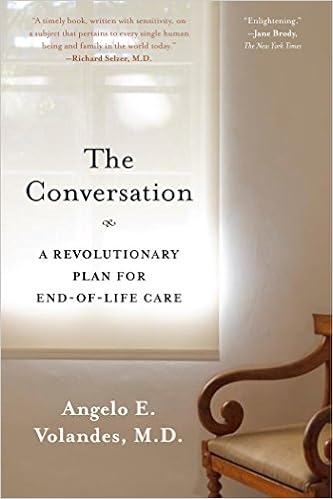
The Conversation: A Revolutionary Plan for End-of-Life Care

Ebook Free The Conversation: A Revolutionary Plan for End-of-Life Care
Outstanding The Conversation: A Revolutionary Plan For End-of-Life Care book is consistently being the most effective buddy for investing little time in your workplace, night time, bus, and also almost everywhere. It will certainly be an excellent way to just look, open, and also review the book The Conversation: A Revolutionary Plan For End-of-Life Care while because time. As understood, encounter as well as ability do not constantly included the much money to acquire them. Reading this book with the title The Conversation: A Revolutionary Plan For End-of-Life Care will let you recognize much more points.
There is no question that book The Conversation: A Revolutionary Plan For End-of-Life Care will certainly constantly offer you motivations. Even this is just a book The Conversation: A Revolutionary Plan For End-of-Life Care; you could discover lots of styles and also sorts of publications. From delighting to experience to politic, as well as scientific researches are all supplied. As what we mention, below we provide those all, from well-known authors as well as author in the world. This The Conversation: A Revolutionary Plan For End-of-Life Care is among the compilations. Are you interested? Take it now. Exactly how is the means? Read more this article!
Yeah, soft data ends up being a reason that you have to read this book. If you bring the published publication for some areas, it will certainly make your bag to be heavier. When you can stick with the soft file, it will not should bring hefty thing. Nonetheless, the The Conversation: A Revolutionary Plan For End-of-Life Care in soft documents can be an option when you go for some areas or only stay at house. Please read this book. It is not only the suggestion; it will be ideas for you as well as you're your life to progress much better.
ever fret if this The Conversation: A Revolutionary Plan For End-of-Life Care is not your favourite publication. We are below not only giving the only publication. You could browse the title in this internet site as well as find the hundreds collections of the books. You recognize, guides that we give are originating from all collections and publisher in the world. You could select title to title to get guides to review. Yet formerly, juts try to get this publication since it's very appealing. Attempt it and comment!
Review
"A timely book, written with sensitivity, on a subject which pertains to every single human being and family in the world today." - Richard Selzer, MD, author of MORTAL LESSONS"For too long, a conspiracy of silence has stood between Americans and the quality care they need, want, and deserve. The Conversation could change all that. Good quality care requires that the treatments are consistent with the values, preferences, and priorities of the people we serve. Now, through the stories in The Conversation, Dr. Volandes shows how skillful communication can make the best of even the hardest situations." - Ira Byock, MD, professor, Dartmouth's Geisel School of Medicine; Chief Medical Officer, The Institute for Human Caring; author of THE BEST CARE POSSIBLE and DYING WELL"My encounter with Dr. Angelo Volandes changed the way I think about life's most precious weeks and hours, and gave me hope for a better future. Your encounter with this passionate humanitarian and the heartbreaking, inspiring stories he tells will affect you the same way." - Jonathan Rauch, Senior Fellow, The Brookings Institution"Through seven stories of seven patients, Angelo Volandes movingly and evocatively tells the tale of how American healthcare does death wrong, often with tragic consequences, and how we can do it right. This is a book about how to live life as well as possible right up until the end, and it should be required reading for anyone who is mortal." - Shannon Brownlee, author of OVERTREATED"Part memoir, part tales from the trenches, part guide, The Conversation shows how medicine fails patients with serious illness, then offers a different, better approach to improve not only how we die but--more importantly--how we live." - Louise Aronson, MD, Director, Northern California Geriatrics Education Center and UCSF Medical Humanities"Volandes has done more than anyone to translate the incomprehensible and the unimaginable into clear visual terms for real human beings trying to decide how they want to be cared for in the future." - Diane Meier, MD, Director of the Center to Advance Palliative Care; Professor of Geriatrics & Palliative Medicine, Mount Sinai School of Medicine"Worth the price of the book alone is Volandes’ easy-to-follow guide for determining and making known one’s end-of-life wishes." - Booklist"Written with passion and clarity, this book moves beyond others on the topic by including empirical evidence of how to make such conversations about end-of-life care most effective." - Library Journal"Appropriately, Volandes neither attempts nor claims to be impersonal or unemotional about this charged topic; rather, he brings his personal and professional experiences as well as research to his impassioned argument . . . [He]makes his points succinctly and convincingly and offers readers the tools to make change within their own lives." - Shelf Awareness"A thoughtful and thought provoking book that confronts the fear of death with the grace of wisdom and understanding." - Spiritualty and Health"Enlightening." - Jane Brody, The New York Times
Read more
About the Author
Angelo Volandes is a physician, writer, and patients' rights advocate. He practices internal medicine at Massachusetts General Hospital in Boston, and is on faculty at Harvard Medical School. He is Co-Founder and President of Advance Care Planning (ACP) Decisions, a non-profit foundation implementing systems and technologies to improve the quality of care delivered to patients in the health care system.Born and raised in Brooklyn, NY, he was educated at Harvard, Yale, and the University of Pennsylvania. He lectures widely across the country, and spends his time in Massachusetts with his wife Aretha Delight Davis, MD, JD and their two daughters.
Read more
Product details
Paperback: 240 pages
Publisher: Bloomsbury USA; Reprint edition (January 5, 2016)
Language: English
ISBN-10: 1620408554
ISBN-13: 978-1620408551
Product Dimensions:
5.3 x 0.6 x 7.9 inches
Shipping Weight: 12.6 ounces (View shipping rates and policies)
Average Customer Review:
4.6 out of 5 stars
118 customer reviews
Amazon Best Sellers Rank:
#85,095 in Books (See Top 100 in Books)
Underway in this country is a monumental effort to transform healthcare, driven by the need to reduce waste, redundancy, and danger . What Dr. Volandes brings to the table is visibility into the lives of those who struggle to find their way through this complicated, confusing, and intimidating medical industrial complex and reveals the simple yet profound notion that we can take back control of what happens to us. What is astounding is that to take control we must start with the simple act of conversation. When we, as healthcare providers, caregivers, family members and loved ones can lovingly and courageously discuss what is most important to a person at the end of life, we can support and honor that person. We can ensure that he or she is treated in a manner consistent with what defines them; in short, we can change the world. This book puts us on that path.
Medical Doctor Volandes offers a plan for terminal patients to share with their family members and loved ones concerning how and when their lives should end. He informs the reader that “only 24 percent of Americans older than sixty-five die at home; 63 percent die in hospitals or nursing homes, sometimes tethered to machines, and often in pain†(3). He blames the medical profession—doctors like him— for their failure “to have discussions with patients about how to live life’s final chapter†(3). If you should become a terminally ill patient, you must have The Conversation with your doctor.I am reminded of a scene from the Mike Nichols’s 2001 HBO film Wit (based on Margaret Edson’s play), starring Emma Thompson as a highly educated woman dying from late-stage Ovarian cancer. A kind nurse played by Audra McDonald asks Thompson what her wishes are when her heart stops. Thompson indicates she prefers DNR status: Do Not Resuscitate. Thompson’s young intern, a former university student of hers, makes an error on her chart, and the Full Code treatment to revive her ensues instead. McDonald, fortunately, is on hand to remind the doctor, and Thompson is allowed to die in relative peace—as she’s wished. All too often, according to Volandes, Americans are not afforded the courtesy of having The Conversation, and patients are subject to CPR, when statistics show that only a small number of the elderly survive such efforts.At the same time, Volandes explains that medical doctors are trained in the following manner: “To doctor patients is to learn how not to die†(8). They and their staffs often can’t help themselves. With all the lifesaving equipment and procedures available to them, physicians forget the old saw, “First, do no harm,†and forge ahead because they can. Volandes states, “Patients can drive change by having greater knowledge of their options, while doctors can drive change by communicating and advocating for those choices . . . every doctor knows that in the end, we all find ourselves on the patient’s side of the stethoscope†(9).Most of the research, he tells us, indicates that terminal patients are healthier and have a better outlook at the end of their lives if they know what their choices are, and the two choices are pretty much this: you either want to be at home, made comfortable with pain control, or you want to be Full Code, where the hospital staff does everything to keep you alive until your loved ones say “Turn it off.†The doctor’s book is simply written and lacks the dry, overladen rhetoric of medical speak. Instead, he employs moving anecdotes about patients facing the end of their lives, including one about his own father. He describes the video [...] he produces to screen for patients and their loved ones to help them decide how their lives should end, instead of, defaulting to the hospital.I plan to keep The Conversation handy and study it when and if the time arrives. I could always get hit by a truck!
This book is part of what really is a revolutionary approach to health care as the end of life approaches -- treat the patient, not the disease. Doctor Volandes wants patients and their doctors to think about the health care they want when an illness reaches the point where a cure is unlikely. The way he wants patients to think about it is by learning what various alternative kinds of care entail, and by talking about what they want -- openly and honestly, with their loved ones and their doctors. Do they want medical professionals to "do anything"? Do that want some support of functions that are failing, but not the most drastic? Or do they want comfort care, in which everything possible is done to eliminate pain and discomfort, but in which drastic measures are not taken.If no decision is made, Dr. Volandes points out, the medical default is to do anything to keep the patient alive; that's what medical ethics call for unless the patient orders otherwise, and that's how the system works. Allowing this to happen, or in fact deciding to "do anything" often has nothing to do with treating the illness itself, but consists of treating the conditions that arise from it -- CPR when the heart stops, a ventilator when breathing fails, a feeding tube when the patient cannot eat. These may prolong life, but the quality of life that results can be miserable. For those who are already at that point, or who have loved ones at that point, these are decisions that need to be made, or the default will apply. Some may in fact choose the "do anything" option: that's their choice. But many others will choose not to accept drastic treatment, and will focus instead on care that keeps the comfortable. These are choices that need to be considered, and communicated clearly before a crisis arises.For those of us who are not ill, but who are getting on, these are also choices that should be considered and communicated. If nothing else, it can spare our loved ones a great deal of anguish when our time comes. Dr. Volandes way of doing this is what he calls "The conversation". He provides ways of approaching this, and he also talks about ways of communicating one's wishes once choices have been made -- living wills, health care proxies, and so on and so forth.This is a compassionate "how to" guide to making -- and communicating! -- choices that older people should make.
I received my copy of The Conversation yesterday, and read the whole thing, cover-to-cover. Angelo's book is so important; everyone must read it. We will all face end-of-life issues sometime in our lifetime, and it could be sooner than we think. As someone who has been dealing with terminal lung cancer for over 6 years, I should have already had The Conversation, but I have put it off. No longer! Angelo has given me the courage and the information I need to talk to my sons - and doctors - about this very difficult topic.I waited too long to have The Conversation with my mother; she's still alive at 94, but has severe dementia. As her health care proxy, I only hope I will make the right decisions for her in the end, which will be soon. She has only said she wants DNR. Angelo makes it clear that we need much more specific, personal information.I'm so glad Angelo has written this book. I am going to gift it to many of my friends and family.
The Conversation: A Revolutionary Plan for End-of-Life Care PDF
The Conversation: A Revolutionary Plan for End-of-Life Care EPub
The Conversation: A Revolutionary Plan for End-of-Life Care Doc
The Conversation: A Revolutionary Plan for End-of-Life Care iBooks
The Conversation: A Revolutionary Plan for End-of-Life Care rtf
The Conversation: A Revolutionary Plan for End-of-Life Care Mobipocket
The Conversation: A Revolutionary Plan for End-of-Life Care Kindle
0 komentar:
Posting Komentar